What the charts reveal about strategic intelligence
27 May 2026
Posted on Discover and learn
Tags: Equipo InTool
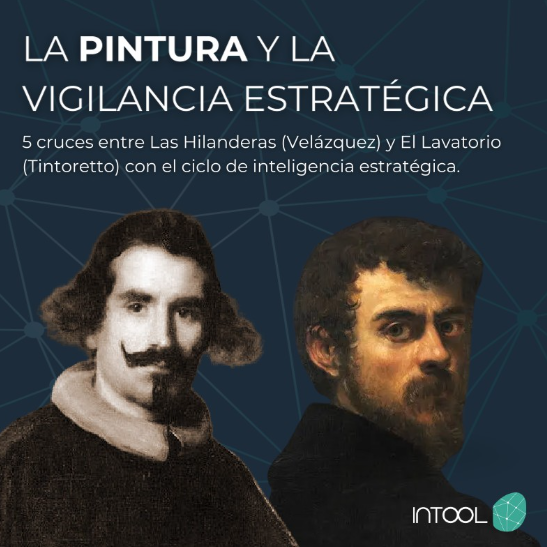
According to our colleague Iñaki Liébana, his love of painting and his work in strategic intelligence are more similar than one might think.
Two paintings that bring them to mind every time I look at them again.
Velázquez’s Las Hilanderas and Tintoretto’s El Lavatorio de Tintoretto
- Things aren’t always what they seem
- For centuries, everyone saw Las Hilanderas as a simple scene from a sewing workshop. It wasn’t until the 20th century that anyone realised it concealed an entire mythological story. The same is true in strategic intelligence: the data in front of you rarely tells the whole story. You have to learn to dig a little deeper.
- What you see depends on your perspective
- Tintoretto’s El Lavatorio de Tintoretto is a fascinating example: if you look at it head-on, the composition seems chaotic. But if you shift your gaze to the right, everything falls into place. The same applies to strategy — the same piece of information can lead you to completely different conclusions depending on the angle from which you analyse it.
- Knowing where to look is the key
- Velázquez places the most important part of the painting in the background, almost hidden. If you don’t know what you’re looking for, you’ll miss it. In strategic intelligence, one of the biggest challenges is precisely that: not getting lost in the noise and being able to identify which information really matters.
- Knowledge is built up in layers, just like a painting
- In Las Hilanderas, there is a tapestry that copies Tiziano, which Rubens then copied, and which Velázquez later interpreted. Each artist built upon the work of the one before them. Strategic intelligence works in the same way: information is transformed into knowledge, that knowledge is shared, and better decisions are made on the basis of it.
- It’s not enough just to look; you have to get involved
- These charts don’t work if you just glance at them. They ask you to stop and think, to ask yourself questions, to get involved. Strategic intelligence isn’t something you consume passively either — it requires the team to get involved, share what they know, and use that information to make informed decisions.